The whole coast · Stone towns
Swahili doorways and what is carved on them
In Lamu and in Mombasa's Old Town, the most elaborate thing on many houses is the front door. Learn its parts and patterns, and the lanes start to read like a book.
- The tide
- Tide hardly matters
- From Mombasa
- Mombasa Old Town, or north to Lamu
- Kindest months
- Any month, cooler mornings best
Walk through Lamu's lanes or the older streets of Mombasa and you soon start to look at doors. The walls around them are plain: whitewashed or grey coral stone, rough plaster, a small window high up. Then, set into the wall, comes a door of dark, heavy wood, its frame thick with carving, its leaves studded with brass. On a Swahili house, the door is where the household showed its standing to the street.
The wall around the door
The old houses of the coast were built of coral rag, irregular lumps of fossil coral quarried near the shore, set in lime mortar and plastered with lime. The walls are thick, which keeps the rooms cool. Floors and roofs were carried on mangrove poles laid side by side, which is why rooms in the old houses are long and narrow: a room could be no wider than a pole could span.
From the outside, a house shows little. Windows on the ground floor are few and small. Privacy mattered, and the life of the house faced inwards, onto a courtyard. That makes the door all the more important. It was the one place where the family's wealth and taste met the eyes of the town.
The parts of a carved door
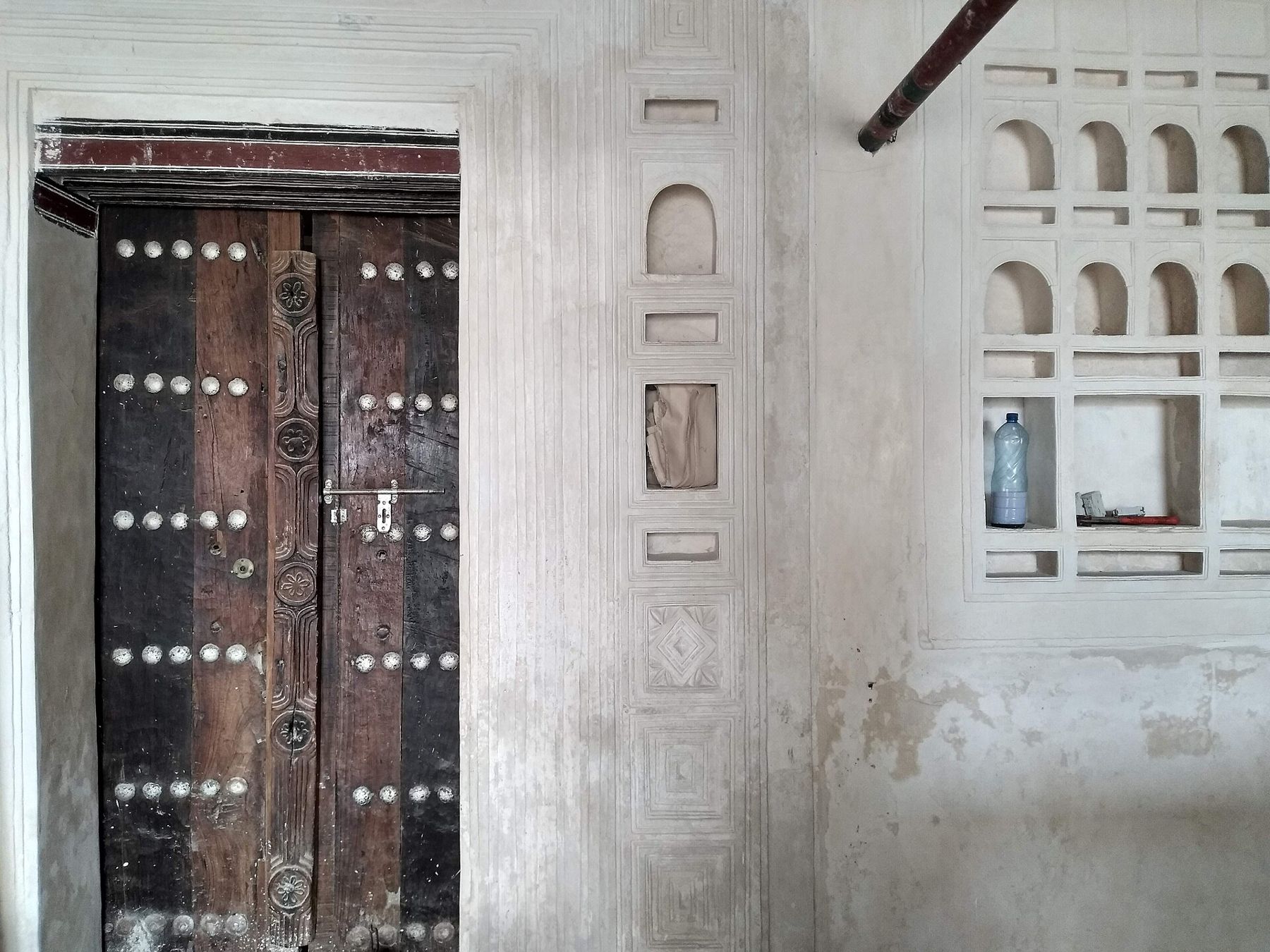
A classic Swahili door has a few clear parts. The frame runs up both sides and across the top, often carved in deep relief. Above the door sits a heavy lintel, sometimes with an inscription in Arabic, often a verse or a blessing, and sometimes a date. The two door leaves meet in the middle, and one of them carries a central post, carved along its length, that covers the join when the doors are closed.
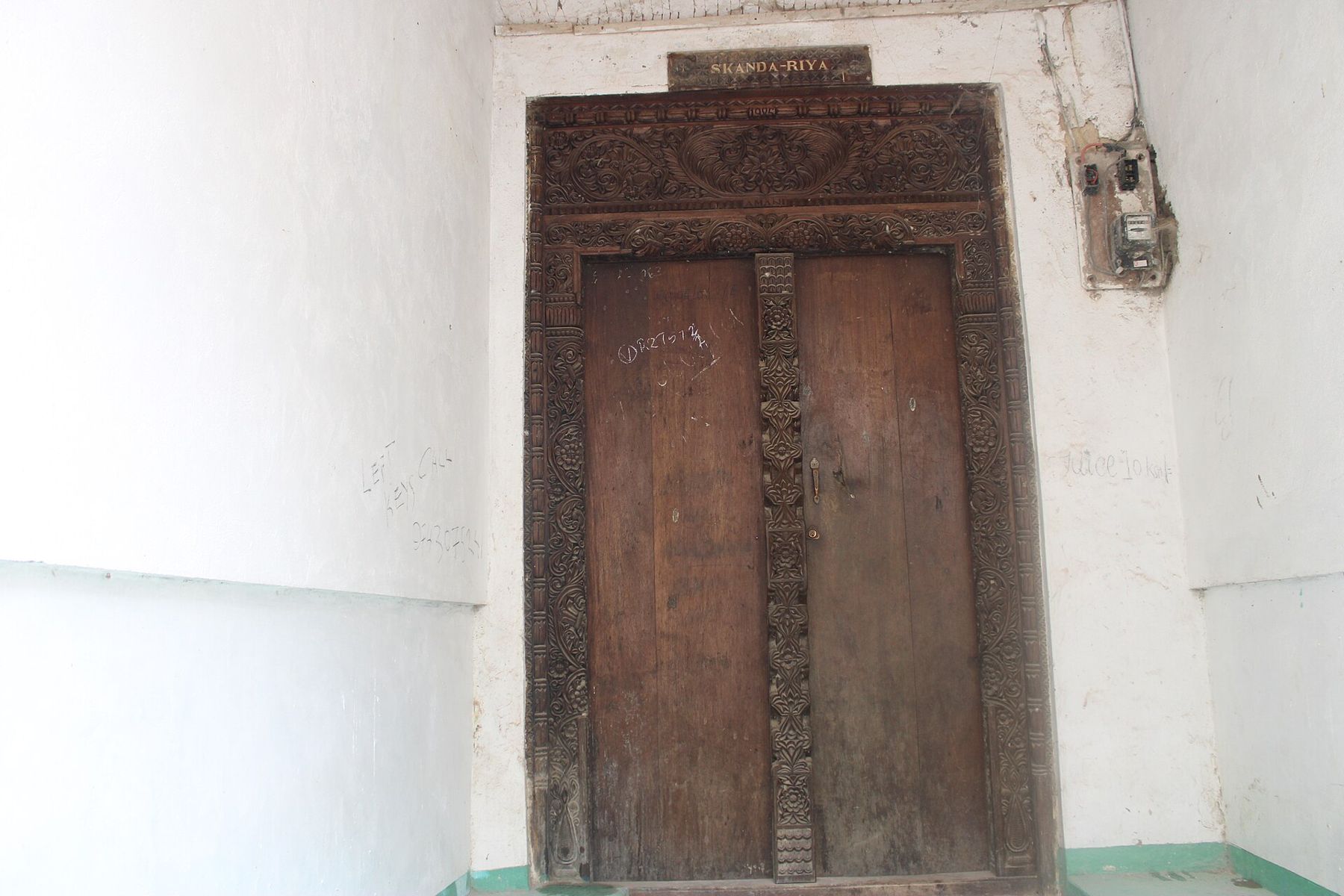
Doors on this coast are often described in two broad styles. In one, the frame is square and the carving is the main decoration, cut in bands of pattern. In the other, often called Indian or Gujarati, the top of the frame may be shaped, and the door leaves carry rows of brass studs or bosses. Many doors mix the two. Both show the same thing: a coast that took ideas from Arabia, Persia and India and made them its own.
Mombasa · Stone townsMombasa Old Town on footReading the carved patterns
Look closely at the carving and you will find motifs repeating from door to door. The meanings given to them are traditions rather than rules, and different people will tell you different things, but some are told often.
- The chain. A carved rope or chain running up the frame, often said to stand for security, or for the bond of the family.
- The lotus. A flower motif linked with fertility and plenty.
- The fish. A reminder of the sea and the living it gives.
- Frankincense and date palm. Plants tied to the Arabian trade and to wealth.
- Geometric bands. Rosettes, stars and interlace, carried over from Islamic design.
The brass studs have their own story. One version says they began in India, where spikes on doors kept war elephants from battering them down, and came to the coast as decoration. Whether or not that is true, on a Swahili door they are a mark of status, polished and set in neat rows.
Behind the door
Step into a traditional merchant house, where it is open to visitors as a museum, and the plan unfolds. Outside the door there is often a stone bench, the baraza, where men of the house sat to talk with neighbours. Inside, a porch leads to a courtyard open to the sky. Around it lie long reception rooms, and deeper in, the family's private rooms.
The inner walls carry some of the finest work in the house: rows of plaster niches, called zidaka, built into the end walls of the main rooms, once used to display porcelain and other prized objects. Some houses carry the same plasterwork into the entrance itself, so the door sits beside a wall of niches and panels. The doors open onto one world, the niches show off another.
Where to find the doors
Lamu
Lamu has the greatest number of carved doors on the Kenyan coast, and carpenters in the town still make them, for new houses and for buyers far away. Walk the lanes behind the seafront in the morning, when the light falls along them. The story of arriving in Lamu by water covers the town, the fort and the museums.
Mombasa Old Town
Mombasa's Old Town, near Fort Jesus, has fine doors too, and a stronger mix of styles, with carved balconies above many lanes. A walk round Mombasa Old Town on foot passes a number of them.
Looking without intruding
These doors belong to homes, not galleries. People live behind them, and many families have lived there a long time. Look and photograph from the lane, not from the doorstep. Do not push a door that is ajar or peer through it. If someone is sitting on the baraza, greet them first, and ask before you photograph them or their house.
Dress for the old towns: cover your shoulders and knees, men and women alike. Lamu and Mombasa's Old Town are mostly Muslim, and modest dress is a courtesy people notice. Around midday on Fridays, and at prayer times, lanes near mosques fill; step aside and let people pass.
If you want to see doors being made, ask at the woodcarving workshops in Lamu, where visitors can often watch carvers at work. Lamu's woodworking reaches the water as well; the story of dhows, then and now picks up that thread.
Every photograph here was shared under an open licence; the photographers are named on the pictures-by page.